
The simplest way to estimate it in the field is to run as far as you can in 5 or 6 minutes and work out your average speed: with 1,500 m in 6 minutes, your estimated MAS is 15 km/h (4:00 min/km). It is a field estimate, not a laboratory measurement. The calculator below does the maths for you and gives you paces and interval times.
MAS calculator
Choose the test you ran, enter the metres and you will see your MAS, your pace per kilometre, a pace table from 60 to 120% and your interval times. It is free, instant and needs no sign-up.
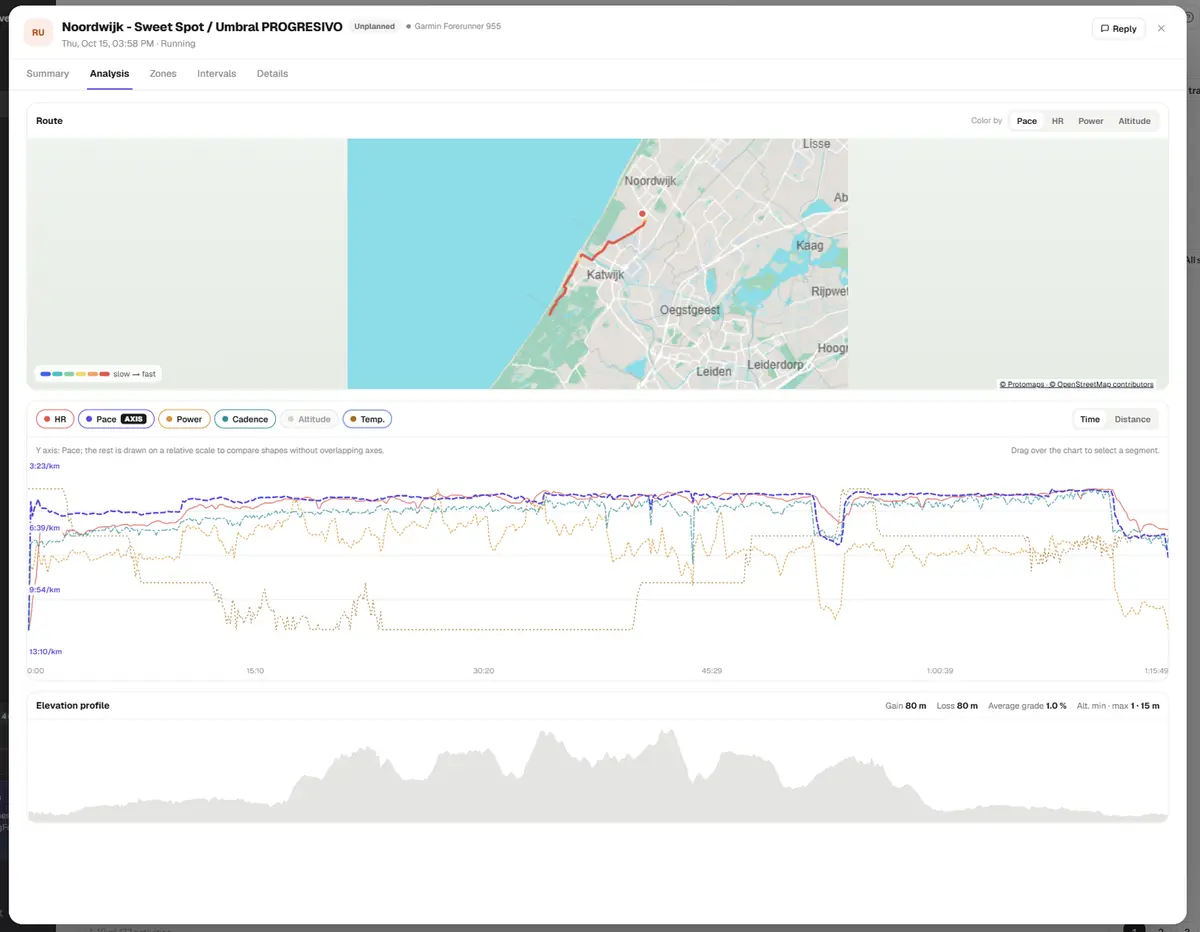
How to run the 6-minute MAS test
The 6-minute test (sometimes called the "half Cooper") is the most common one in running clubs and groups. You run as far as possible in 6 minutes. It is very practical, but it does not have a validation study as widely cited as the one for the 5-minute test.
How to run the 6-minute test properly (steps)
- Warm up for 15–20 easy minutes, with 3–4 strides.
- Use a 400 m track or a flat measured loop. Place cones every 50 or 100 m.
- Start hard but controlled: the classic mistake is going out too fast. Aim for an even pace.
- At 6:00, stop and note the metres (round to the nearest 10 m).
- Calculate: MAS = metres ÷ 100, or enter the metres in the calculator.
- Repeat every 6–8 weeks in similar conditions (surface, time of day, shoes, wind).
Not for everyone: it is a maximal effort. Beginners and anyone with pain or a medical condition should check with a healthcare professional first.
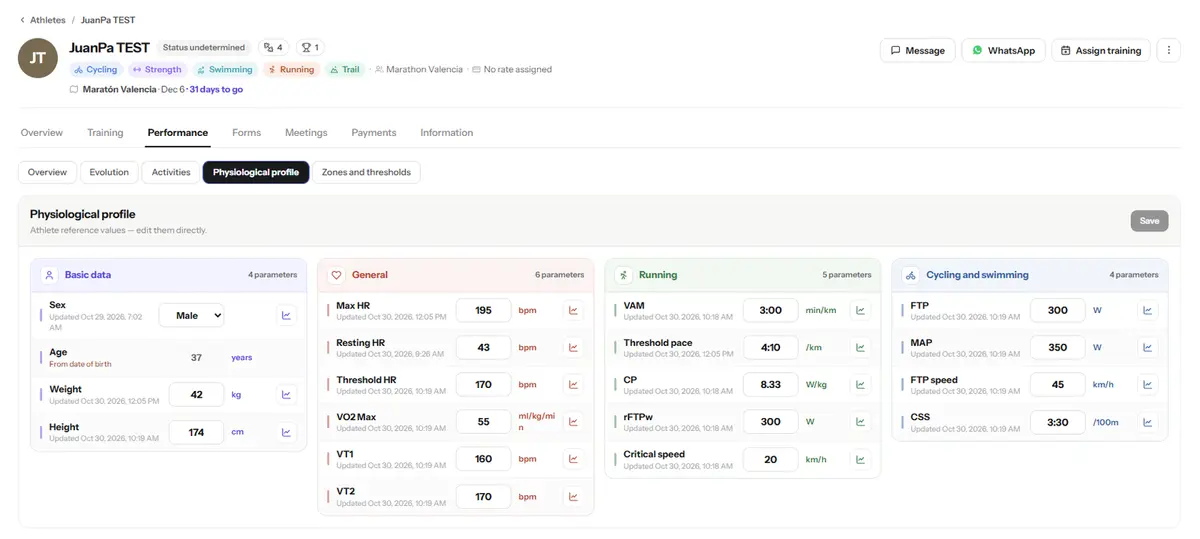
How to run the 5-minute MAS test
The 5-minute test follows the same idea: run as far as possible in 5 minutes on a flat, measured surface. One study compared it with a progressive treadmill test and found a good relationship between the two estimates of maximal aerobic speed (Berthon et al., 1997).
- Calculation: MAS (km/h) = metres ÷ 300 × 3.6, that is, metres ÷ 83.3. With 1,250 m, 15 km/h.
- Same warm-up and same conditions as for the 6-minute test.
- 5 or 6 minutes? They are not equivalent protocols. The shorter the test, the higher the same person's average speed tends to be, so a 5-minute MAS and a 6-minute MAS should not be mixed. Pick one and always repeat it the same way.
MAS formula and worked examples
MAS estimated with a fixed-duration test is your average speed in that test:
- MAS (km/h) = metres covered ÷ test seconds × 3.6.
- Pace at MAS (min/km) = 60 ÷ MAS (or 3,600 ÷ MAS, in seconds per kilometre).
- Speed at a percentage = MAS × percentage ÷ 100.
- Interval time = interval metres ÷ 1,000 × target pace in s/km.
Manual calculation: MAS = metres ÷ 100
In 6 minutes (0.1 h), the metres covered divided by 100 give MAS in km/h. For pace: 60 ÷ MAS = min/km.
| Metres in 6 min | MAS (km/h) | Pace at 100% MAS |
|---|---|---|
| 1,200 | 12.0 | 5:00 min/km |
| 1,400 | 14.0 | 4:17 min/km |
| 1,500 | 15.0 | 4:00 min/km |
| 1,600 | 16.0 | 3:45 min/km |
| 1,800 | 18.0 | 3:20 min/km |
| 2,000 | 20.0 | 3:00 min/km |
Example: 1,540 m in 6 min → 1,540 ÷ 100 = 15.4 km/h → 60 ÷ 15.4 = 3.90 min = 3:54 min/km.
What exactly does MAS measure?
- VO2max: the maximum amount of oxygen your body can use (ml/kg/min).
- MAS: the speed at which you reach that VO2max. It combines your aerobic capacity and your running economy, which is why it is more practical for training than VO2max on its own (Billat and Koralsztein, 1996).
- Time limit at MAS: that speed can only be held for a short time, typically a few minutes, with a lot of variation between people (same source).
Note: in cycling, VAM is a different metric (average climbing speed, in m/h). We explain it in VAM in cycling.
MAS percentages and training paces
With an estimated MAS of 15 km/h, these are the paces for each percentage. The calculator shows the same table with your own MAS.
| % MAS | Speed (km/h) | Pace (min/km) |
|---|---|---|
| 60% | 9.0 | 6:40 |
| 70% | 10.5 | 5:43 |
| 80% | 12.0 | 5:00 |
| 90% | 13.5 | 4:27 |
| 100% | 15.0 | 4:00 |
| 110% | 16.5 | 3:38 |
| 120% | 18.0 | 3:20 |
These are percentages of your estimated MAS, not universal physiological zones. Two runners with the same MAS can tolerate 85% or 105% very differently, and above 100% we are talking about supramaximal paces that can only be held in short repetitions.
How to train with your estimated MAS
Guide ranges commonly used in interval training (see Billat, 2001, part I and Buchheit and Laursen, 2013). Always adjust them to your athlete:
| % MAS | Typical use | Sample session |
|---|---|---|
| 60–70% | Easy running, recovery | 45' continuous |
| 75–85% | Steady pace (as a guide) | 3 × 10' |
| 85–90% | Threshold pace (as a guide) | 2 × 15' |
| 95–105% | VO2max intervals | 30"-30" (30" at 100% MAS + 30" easy) |
| > 105% | Short speed repetitions | 10 × 200 m |
MAS gives a shared starting point, but terrain, heat, accumulated fatigue and the time of the season change what each percentage means on a given day. That is why it works best combined with perceived effort and with what the coach observes.
Real case: how does Marc Bañuls use it?
Real case: Marc Bañuls, a coach with more than 15 years of experience. "MAS gives me a starting point, but I never use it on its own: if an athlete arrives tired or the terrain is different, the pace adapts. The number helps; the decision is mine." "I repeat the test every few months and in the same conditions. If you change the track or the day, you are comparing apples and oranges."
How is MAS used in TrainingForever?
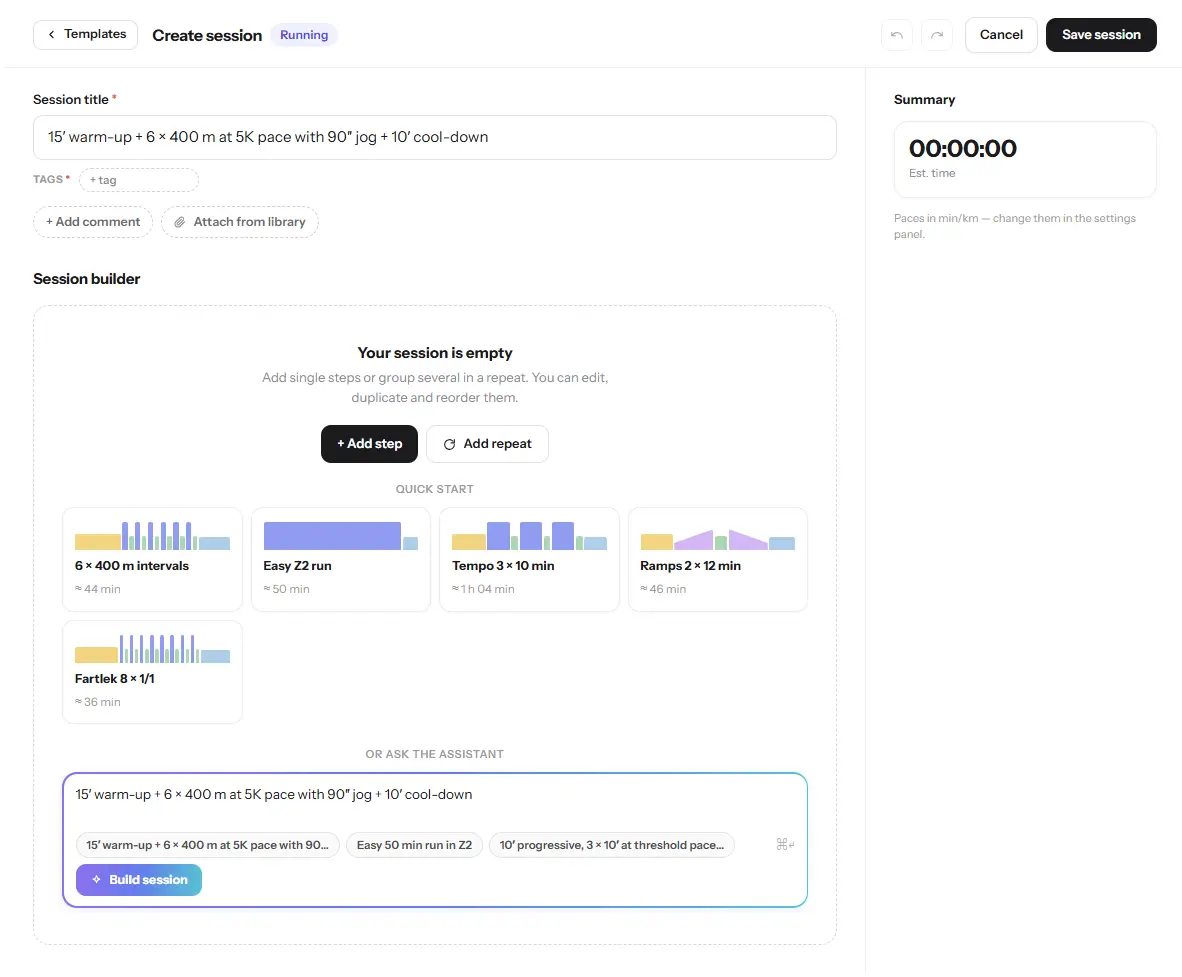
You schedule the test like any other session and, with the result, you decide whether to update the athlete's paces and zones. The AI Assistant can suggest a draft block with paces derived from MAS, which you review and publish.
If you coach several athletes and are looking for somewhere to keep their tests and paces, compare options in our guide to the best software for personal trainers.
Practical MAS interval examples
With an estimated MAS of 15 km/h, these are the target times for some common intervals. The number of repetitions and the recovery do not come from MAS: they depend on the athlete's level, the goal and the phase of the season.
| Interval | % MAS | Pace | Time per repetition |
|---|---|---|---|
| 30 s fast + 30 s easy | 100% | 4:00 min/km | 125 m in 30 s |
| 200 m | 110% | 3:38 min/km | 0:44 |
| 400 m | 100% | 4:00 min/km | 1:36 |
| 400 m | 105% | 3:49 min/km | 1:31 |
| 1,000 m | 95% | 4:13 min/km | 4:13 |
| 1,000 m | 90% | 4:27 min/km | 4:27 |
If you are preparing a half marathon, bear in mind that MAS is not your race pace: half marathon pace is usually well below MAS, and the ratio varies a lot from one runner to another. You will find specific sessions for that distance in half marathon interval workouts.
Limitations of MAS field tests
- It is an approximation. The average speed of a 5- or 6-minute test estimates MAS but does not measure it: laboratory methods (a progressive test with gas analysis) or validated progressive field tests can give different values (Bosquet et al., 2002).
- It depends on pacing. Starting too fast or holding back changes the result.
- It depends on conditions: surface, wind, heat, shoes, motivation and prior fatigue.
- How long people can hold MAS varies widely (Billat and Koralsztein, 1996), so a fixed-duration test suits some runners better than others.
- 5 and 6 minutes are not equivalent. Do not convert a MAS from one test into the other: always repeat the same one.
Other field tests to estimate MAS
| Test | Protocol | Calculation | Support |
|---|---|---|---|
| 6-minute test | Maximum distance in 6 min on a track | MAS = m ÷ 100 | Very widespread field practice |
| 5-minute test | Maximum distance in 5 min | MAS = m ÷ 83.3 | Compared with a treadmill test: Berthon et al., 1997 |
| Université de Montréal Track Test (UM-TT) | Progressive with audio signals until exhaustion | Speed of the last completed stage | Léger and Boucher, 1980 |
| Cooper test | Maximum distance in 12 min | Estimates VO2max (not MAS directly) | Cooper, 1968 |
Frequently asked questions
How do you calculate MAS with the 6-minute test?
Divide the metres covered by 100. 1,600 m = 16 km/h.
How do I convert MAS into min/km?
Divide 60 by your MAS. At 15 km/h, 60 ÷ 15 = 4 minutes: 4:00 min/km.
Are MAS and VO2max the same thing?
No. VO2max is the maximum oxygen you consume; MAS is the speed at which you reach it.
How often should you repeat the test?
Every 6–8 weeks or at the start of a new block, in similar conditions (as a guide: adjust it to each athlete).
Is the 5-minute or the 6-minute test better?
The 5-minute test was compared with a treadmill test in a published study (Berthon et al., 1997). The 6-minute test is widely used in practice. They do not give exactly the same result, so what matters is always using the same test with the same athlete.
Is MAS my half marathon pace?
No. MAS is a speed you can only hold for a few minutes; half marathon pace is considerably slower and cannot be derived from a fixed percentage of MAS.
What does VAM mean in cycling?
It is a different metric: average climbing speed, in metres per hour. We explain it in VAM in cycling.
Sources
- Billat LV, Koralsztein JP. Significance of the velocity at VO2max and time to exhaustion at this velocity. Sports Med. 1996;22(2):90-108. doi:10.2165/00007256-199622020-00004
- Berthon P, et al. A 5-min running field test as a measurement of maximal aerobic velocity. Eur J Appl Physiol Occup Physiol. 1997;75(3):233-8. doi:10.1007/s004210050153
- Léger L, Boucher R. An indirect continuous running multistage field test: the Université de Montréal track test. Can J Appl Sport Sci. 1980;5(2):77-84. PMID 7389053
- Cooper KH. A means of assessing maximal oxygen intake. JAMA. 1968;203(3):201-4. PMID 5694044
- Bosquet L, Léger L, Legros P. Methods to determine aerobic endurance. Sports Med. 2002;32(11):675-700. doi:10.2165/00007256-200232110-00002
- Billat LV. Interval training for performance… Part I: aerobic interval training. Sports Med. 2001;31(1):13-31. doi:10.2165/00007256-200131010-00002
- Buchheit M, Laursen PB. High-intensity interval training, solutions to the programming puzzle. Part I: cardiopulmonary emphasis. Sports Med. 2013;43(5):313-38. doi:10.1007/s40279-013-0029-x (Metadata checked on PubMed and Crossref on 04/11/2026.)