
The series are the most specific part of the preparation of a half marathon. Here are 6 sessions with their structure and paces. To estimate your paces, use the MAS calculator or the worked example at the end.
Rapid response: For a half marathon, the most useful series are long repeats at race rate or something faster (from 1 to 5 km), with short recoveries, plus some session at 10K pace to gain margin. One or two quality sessions per week are sufficient; the rest of the volume, soft (Seiler, 2010).
Your reference paces
| Pace | What is it? | Feeling |
|---|---|---|
| Median pace (RMM) | The pace you want to run the race to | Demanding but sustainable |
| 10K pace | Something faster than the RMM | Hard, very short sentences |
| 5K pace | Faster than the 10K beat | Very hard |
| Soft | Rolling and reclamation | You can talk. |
If you are not sure what pace to run your intervals at, you can estimate your maximal aerobic speed with our MAS calculator and get guide paces for different intensities. Note that MAS is not your half marathon pace: it is a reference for setting intensities as a percentage of that speed (Billat, 2001).
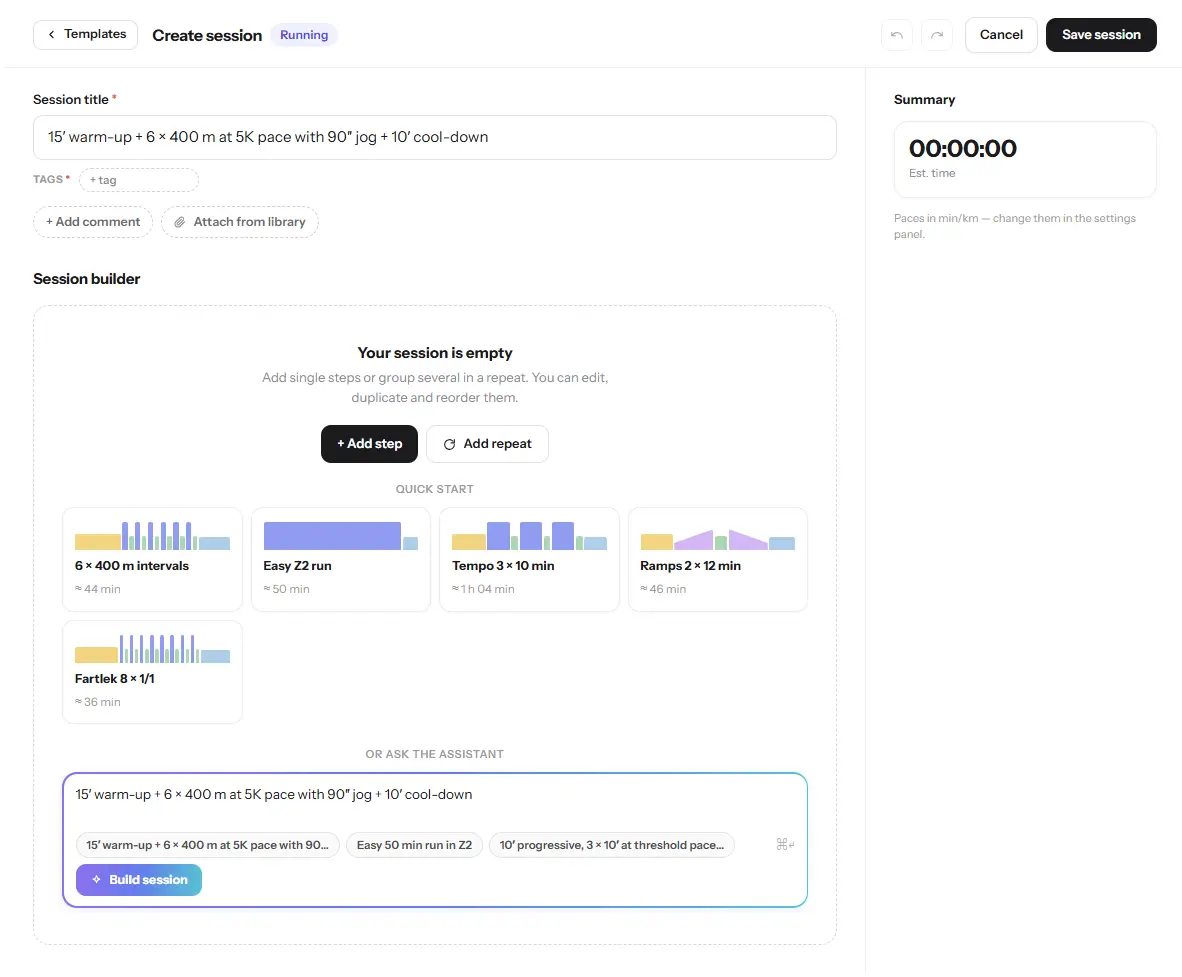
The 6 meetings
| # | Meeting | Objective |
|---|---|---|
| 1 | 3 × 3 km to RMM, recovery 2 min to jogging | Assimilating the pace of race |
| 2 | 6 × 1000 m at pace 10K, recovery 90 s | Winning margin over the RMM |
| 3 | 5 × 2000 m between RMM and 10K pace, recovery 2 min | Threshold and pace endurance |
| 4 | 2 × 6 km to RMM, recovery 3 min | Long specific session (advanced level) |
| 5 | Soft long throw with the last 4-5 km to RMM | Running the pace with fatigue |
| 6 | 8 × 400 m at pace 5K, recovery 1 min 30 s | Speed and economy |
They all start with 15-20 minutes smooth and some progressive, and end with 10 minutes jogging.
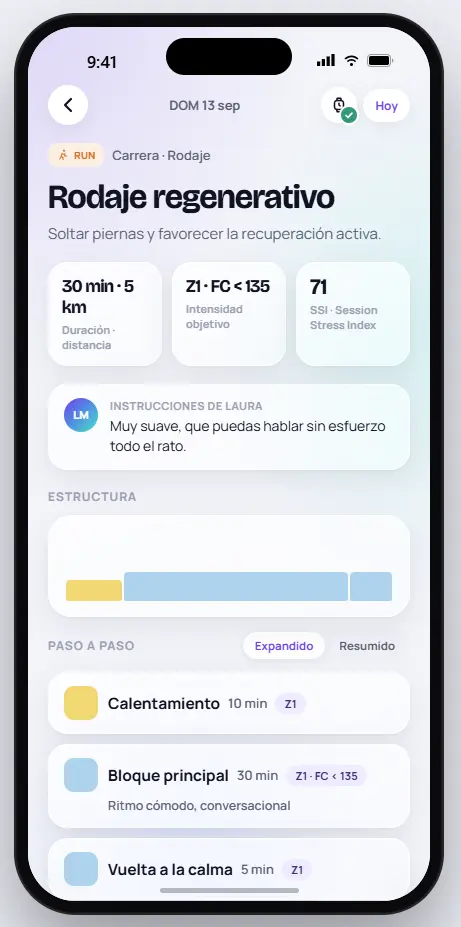
How to fit them into the week
- One or two quality sessions per week, separated by mild days.
- Lots of soft volume: In endurance athletes, most of the training is done at low intensity (Seiler, 2010), and in elite fondistas performance is associated with smooth shooting volume and short series and controlled pace (Casado et al., 2021). TRIMP shows whether that week’s heart-rate load spikes.
- Progression: of sessions 1, 2 and 6 at the beginning, at 3, 4 and 5 in specific weeks.
- Setting up: in the last two weeks, less volume and the same intensity (Bosquet et al., 2007).
Usual errors
- Run the series faster than expected and get empty to the next.
- Cut the smooth shoots to put in more series.
- Do not practice the pace of race with fatigue.
After the race
Spend a few days recovering before you return to quality work. The steps are in recovery after a half marathon. To place these sessions in the block, follow 3:1 periodization and build the week from a training plan. Repetition paces come from the MAS calculator. If the next goal is shorter, try the free 10K plan.
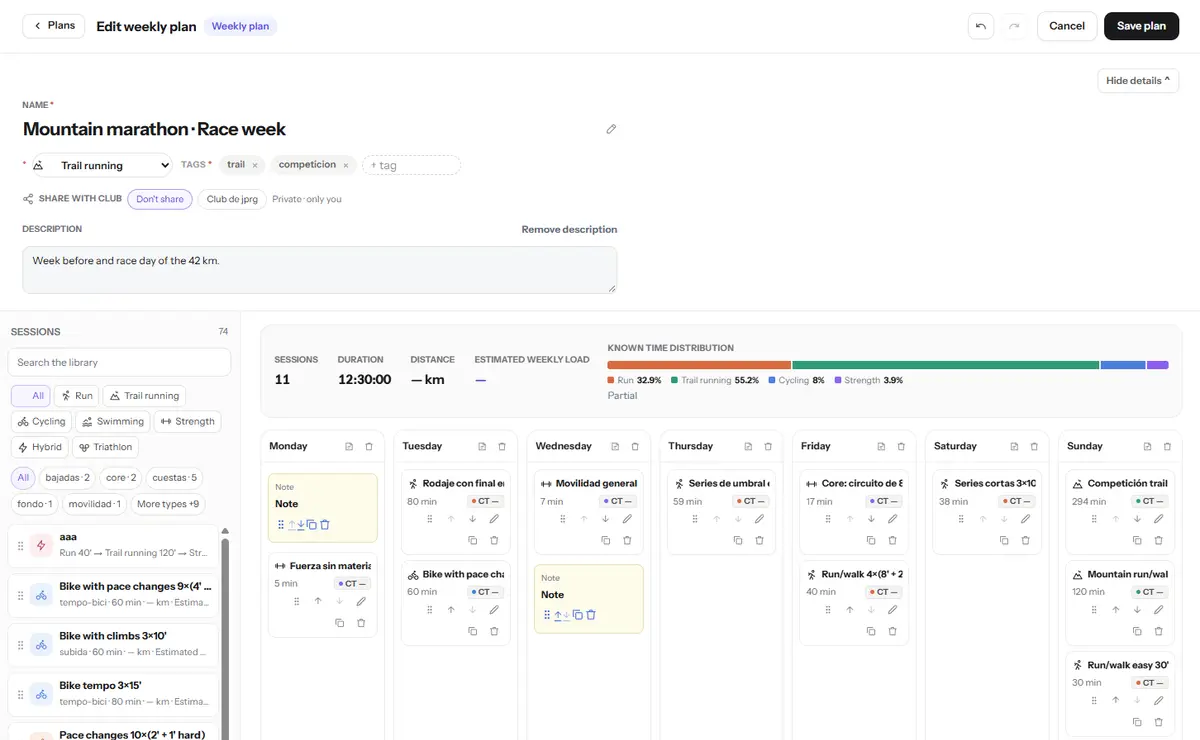
Schedule your series in TrainingForever
In TrainingForever the coach schedules these sessions with his paces and the sessions are synchronized with Garmin Connect. With TrainingForever, your coach has all the features free up to 5 athletes; from there, 0.99 € per active athlete per month, with a maximum of 49 €/month. For the athlete it's always free. If you coach several runners, TrainingForever is endurance coaching software with reusable session templates.
What a Coach Says
«In half marathon the series that perform the most are those that resemble the race: objective pace, short recoveries and quiet head.» — Marc Bañuls, coach with more than 15 years of experience
Worked example: goal pace and 2 km repeats
Half marathon pace is the goal time divided by 21.0975 km. For a session of 5 × 2 km at race pace:
| Goal | Pace (min/km) | Each 2 km rep |
|---|---|---|
| 1:30:00 | 4:16 | 8:32 |
| 1:45:00 | 4:59 | 9:57 |
If the last reps come in slower than goal pace, cut the number of reps before you cut the recovery.
Frequently Asked Questions
How many shows do I do a week for a half marathon?
One or two quality sessions per week are usually sufficient; the rest of the volume, soft.
At what rate do I do the series?
Especially at the rate of half marathon and 10K pace. You can estimate them with the MAS calculator or by dividing your goal time by 21.0975 km.
What is the most specific session?
Long repetitions at race rate, like 2 × 6 km at average rate or a long run with end at that rate.
When do I stop doing series before the race?
No need to leave them: in the last two weeks reduce the volume and keep short sessions at the pace of the race.
How do I calculate my half marathon pace?
Divide the goal time in seconds by 21.0975. For example, 1:45:00 is 6,300 s; 6,300 ÷ 21.0975 ≈ 299 s, about 4:59 min/km.
Sources
- Seiler S. What is best practice for training intensity and duration distribution in duration athletes? Int J Sports Physiol Perform. 2010;5(3):276-91.
- Married A, Hanley B, Santos-Councilor J, Ruiz-Pérez LM. World-class long-distance running performances are best predicted by volume of easy runs and deliberate practice of short-interval and tempo runs. J Strength Cond Res. 2021;35(9):2525-31.
- Billat LV. Interval training for performance: a scientific and empirical practice. Part I. Sports Med. 2001;31(1):13-31.
- Bosquet L, Montpetit J, Arvisais D, Mujika I. Effects of covering on performance: a meta-analysis. Med Sci Sports Exerc. 2007;39(8):1358-65.