By JuanPa, creator of TrainingForever · Updated 4 November 2026
Heart rate responds to exercise, but also to context. An easy run at the same speed can produce a different cardiac response when it's hot or the athlete arrives tired.
Heart rate-based load helps describe the recorded response. To interpret it, it's worth contrasting it with what the person was producing and with how they felt.
What TRIMP contributes
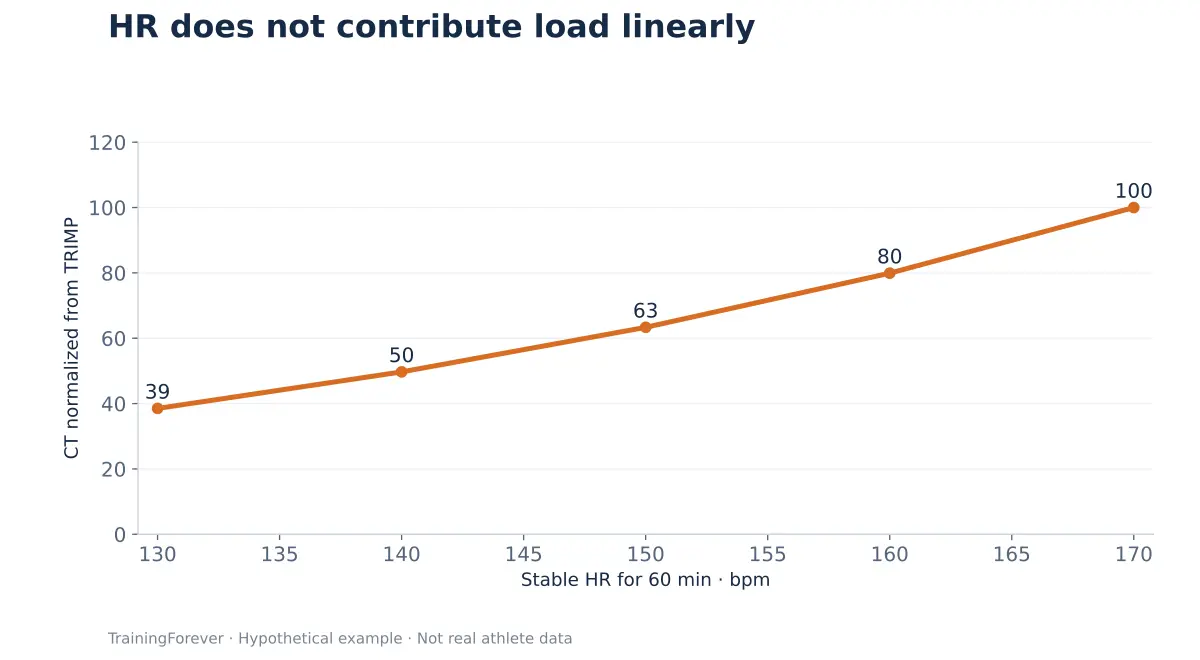
TRIMP stands for training impulse. It combines time and heart rate intensity with a weighting that gives more weight to high intensities. In the branch documented by TrainingForever, the heart rate series is integrated and then normalized to the CT scale.
That's why raw TRIMP and CT derived from TRIMP are different numbers. They shouldn't appear in a comparison as if they were the same unit.
Case: the usual easy run on a hot day
Elena runs her usual route at a similar speed. Her heart rate is higher and reflects more effort.
If CT is calculated from heart rate, it may rise. That doesn't prove she produced more external work, nor does it allow the whole difference to be attributed to training. Temperature, hydration and prior state help explain the response.
The practical decision may be to adjust the purpose of the day: maintain a tolerable effort even if the pace is lower. Chasing the usual pace without attending to context could change the session.
What to check if the number looks strange
| Check | Why it matters |
|---|---|
| Max, resting and threshold HR | They modify the individual reference |
| Quality of the series | Spikes or gaps affect the integration |
| Source of the calculation | Switching from power to heart rate can shift the scale |
| Duration and conditions | They allow similar sessions to be compared |
| Type of training | Heart rate responds with a delay to brief changes |
In short intervals, heart rate may still be rising when the repetition has already ended. A moderate cardiac CT doesn't rule out an intense stimulus or a significant neuromuscular demand.
The calculation explained without developing the whole formula
First, each heart rate value is placed within the cardiac reserve: the difference between resting and maximum. Then it is weighted and the valid time is summed.
Finally, CT normalization takes 60 minutes at threshold heart rate as its reference. If threshold HR is incorrect, that reference will be too. And if the series is missing, using an average loses information about the changes.
The app's fixed coefficient is a convention of the calculation, not an individual description of all cardiac responses. It's worth reviewing its configuration before attributing small differences to adaptations.
How to talk about it with the athlete
"At a similar pace, today your heart rate and your perception of effort were higher. Let's review the conditions and how you arrived; then we'll see if it makes sense to keep the next workout." That sentence uses the data without turning it into a diagnosis.
What this explanation is based on
- Banister EW, Calvert TW (1980). Planning for future performance: implications for long term training. Background on model-based training monitoring.
- Coyle EF, González-Alonso J (2001). Cardiovascular drift during prolonged exercise: new perspectives. Physiological context for interpreting cardiovascular changes during prolonged exercise.
The references support concepts and limits. The numerical examples on this page are educational; they are not results from those studies.