By JuanPa, creator of TrainingForever · Updated 4 November 2026
Recent load can sit above or below the training memory of several weeks. DC summarises that difference to help you place the moment in the plan.
A negative DC does not automatically mean there is a problem, and a positive one does not guarantee you are ready to race. The sign is understood together with the path that produced it.
Look at three different stories
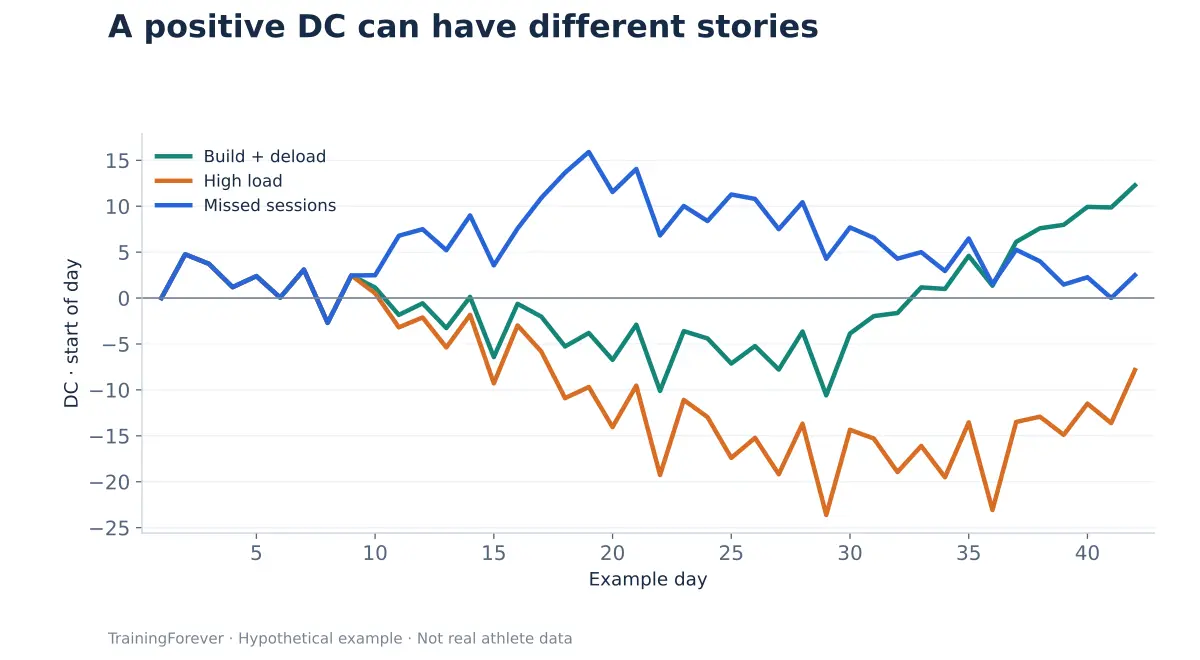
In a loading block, Acute Fatigue (FA) can exceed Chronic Adaptation (AC) and DC will be negative. When recent load drops, FA usually falls faster and DC can turn positive. That can happen because of a planned deload or because training stopped.
An example with simple numbers
| AC at the end of yesterday | FA at the end of yesterday | DC today | What it describes |
|---|---|---|---|
| 45 | 60 | −15 | Greater weight of recent load |
| 45 | 45 | 0 | Equality between both indices |
| 45 | 30 | +15 | Lower recent load relative to slow memory |
These are calculation examples. They do not define optimal zones or clinical limits.
Case: same sign, different decisions
Ana has completed a block and reduces volume before racing. Her DC turns positive. The reading can fit a lower recent load, provided she keeps the relevant work and arrives feeling good.
Luis has missed several sessions for lack of time. His DC also rises, but his AC falls and has moved away from the planned content. With him the priority may be to rebuild a workable plan, not to read the positive as better preparation.
The number looks similar; the decisions rest on different stories.
How to use it during a build
Check whether the separation matches what you were looking for and whether the athlete is responding. A negative DC for a few days can be part of a block. If it combines with persistent bad feelings and worse execution, it is worth reviewing the programming.
There is no isolated value that lets you calculate an injury probability. Adding a colour to the chart does not solve that limitation.
Time of day matters
In the documented daily model, DC_today = AC_yesterday − FA_yesterday. It uses the situation before today's training.
If elsewhere in the panel you read AC and FA after loading the day's session, their subtraction may not match that DC. Before assuming an error, confirm that you are comparing values from the same moment.
In the figures, AC and FA are labelled at close; DC, at the start. That distinction avoids explaining the curve with a temporarily incorrect subtraction.
Questions that justify a decision
- Did the separation appear because of planned load or because of activities that are missing?
- Is the content still specific to the race?
- Do feel and execution back it up?
- What produced similar situations in this person's history?
DC is a synthesis of AC and FA. It does not provide a new datum independent of the body: it helps visualise a relationship the coach must interpret.
What this explanation is based on
- Impellizzeri FM et al. (2020). Acute:Chronic Workload Ratio: Conceptual Issues and Fundamental Pitfalls. It warns of the limits of inferring injury from load ratios; DC is a difference, not that ratio.
The references support concepts and limits. The numerical examples on this page are educational; they are not results from those studies.