By JuanPa, creator of TrainingForever · Updated 4 November 2026
A hard session can greatly change how you feel the next day, but on its own it doesn't rebuild several weeks of preparation. AC offers a slow memory of daily load.
The name Chronic Adaptation does not mean measured physiological adaptation. The figure summarises a history of CT. To check for improvement you need to add performance, execution and the athlete's response.
What to look for in the curve
A sustained build usually raises AC gradually. A relatively stable load tends to keep it steady. Several weeks with less training make it fall.
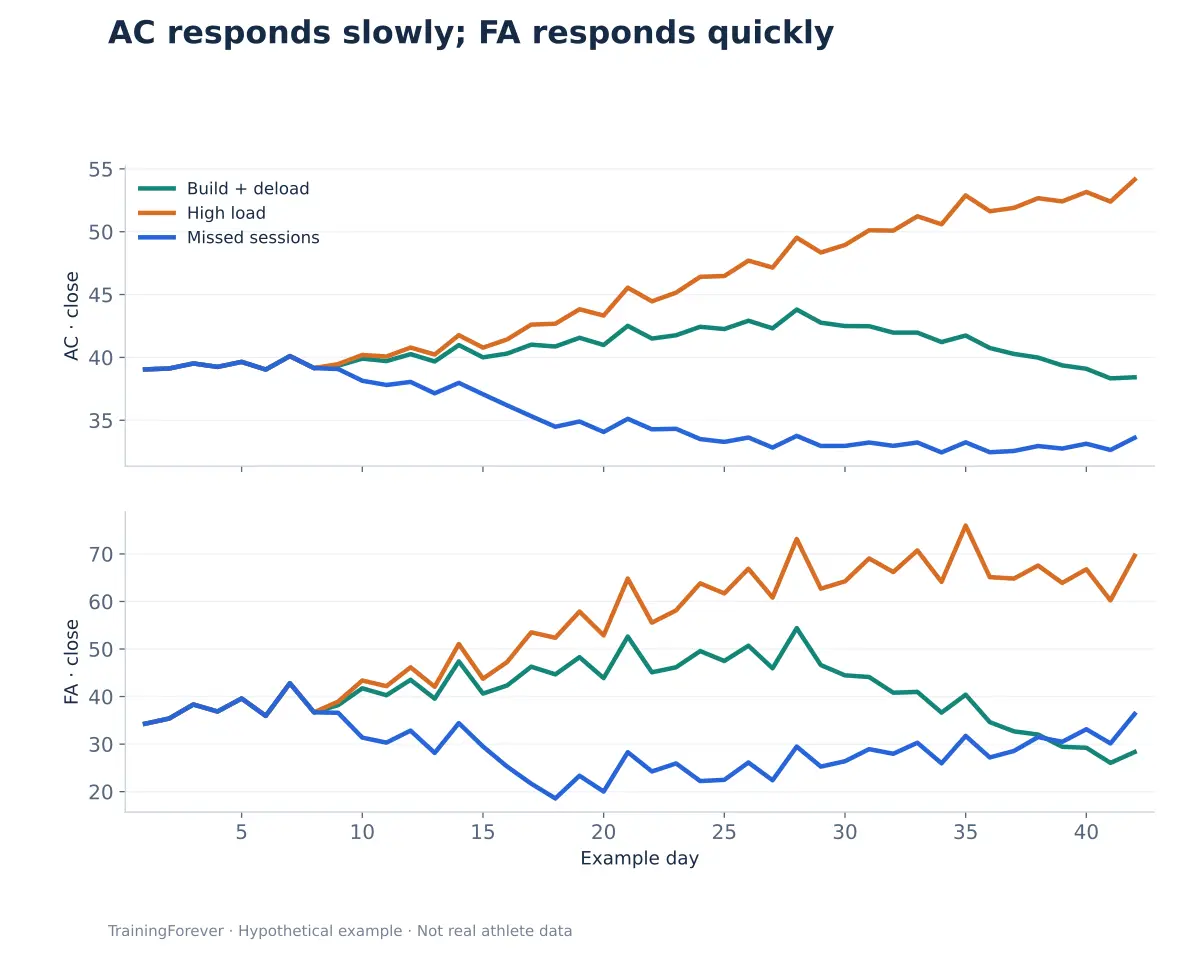
The top part helps you see continuity; the bottom part shows that recent load responds more quickly. The scales are daily indices, not weekly totals.
Case 1: continuity and a planned taper
Ana completes weeks of 280, 315, 350 and 350 CT. In this example, her closing AC goes from approximately 40.1 at the end of the first week to 43.8 in the fourth.
She then reduces load to 210 and 140 CT. AC drops to approximately 38.4 at the end of the sixth. That drop in the model during the taper does not on its own prove a loss of fitness. The purpose may be to arrive at a race with less recent load.
Case 2: several sessions not completed
From the same starting point, another scenario accumulates weeks of 280, 180, 130 and 180 CT. There are training days missed and confirmed. AC sits at around 33.8 at the close of the fourth week.
The conversation changes: did the plan stop fitting her availability? Were the sessions too long? Restoring continuity may be more useful than insisting on the load that was on the calendar.
Don't turn the difference between planned and actual AC into a debt to be repaid in a few days.
Case 3: high AC and poor performance
AC can rise while the athlete performs worse or accumulates bad sensations. The calculation only knows the loads entered; it doesn't confirm that they are being absorbed or that they are specific to the goal.
A rising curve deserves to be checked against key sessions, recovery and context. If the log contains duplicates or the CT method changed, review that before interpreting an apparent progression.
What to review each week
- The trend over several weeks, without obsessing over the last decimal.
- The content and distribution of the sessions that produced that load.
- Sufficient history and no pending activities.
- Correspondence with the goal of the training phase.
There is no universal AC that guarantees being ready for a marathon, trail or triathlon. The same figure can come from very different content.
The calculation, if you need it
The documented daily update is AC_today = AC_yesterday + (CT_today − AC_yesterday) / 42.
It is a discrete exponential filter with a coefficient of 1/42. It is not the arithmetic mean of the last six weeks, nor a window that forgets everything before it all at once. The number 42 is a product setting, not an individual adaptation time.
The most useful sporting use
AC helps you place the continuity of load from which you are planning. Assessing whether that preparation is working needs other evidence.
What this explanation is based on
- Morton RH, Fitz-Clarke JR, Banister EW (1990). Modeling human performance in running. A forerunner of models with training effects of different durations; it does not validate fixed parameters for every athlete.
The references support concepts and limits. The numerical examples on this page are educational; they are not results from those studies.