By JuanPa, creator of TrainingForever · Updated 4 November 2026
Planning is a hypothesis about what the athlete will do. Execution provides information about what happened and how they responded. The two loads differing does not automatically mean the plan or the athlete has failed.
The useful comparison seeks to explain the difference before changing the next session. And it distinguishes a confirmed rest day from an activity that has not yet been recorded.
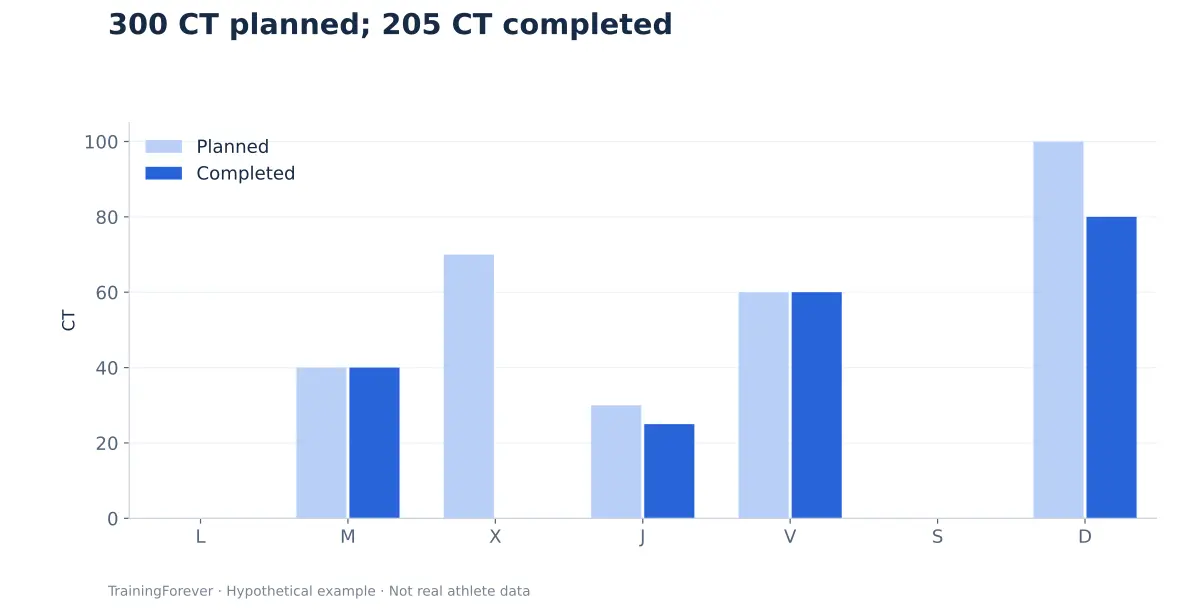
Case: a planned week of 300 CT ends at 205
| Day | Planned | Completed | Example context |
|---|---|---|---|
| Monday | 0 | 0 | Rest |
| Tuesday | 40 | 40 | Completed |
| Wednesday | 70 | 0 | Not performed |
| Thursday | 30 | 25 | Reduced |
| Friday | 60 | 60 | Completed |
| Saturday | 0 | 0 | Rest |
| Sunday | 100 | 80 | Shorter duration |
| Total | 300 | 205 | 95 CT less |
68.3% of the planned CT was completed. It is a descriptor of this example, not a criterion for judging the athlete. Before adding training, find out why the week changed.
What the coach would do
If there was a one-off unforeseen event, reorganize the upcoming priorities without trying to automatically add 95 CT. If it repeats every week, the plan may not fit the person's life.
If the sessions were reduced because of feeling bad, interpreting the deficit as a debt can make the adjustment worse. It is worth looking at which stimuli were preserved and what is needed now.
If the sessions were in fact done but files are missing, the first task is to complete the record. A chart with less data can look like a download that never happened.
The future of the curve is not a result
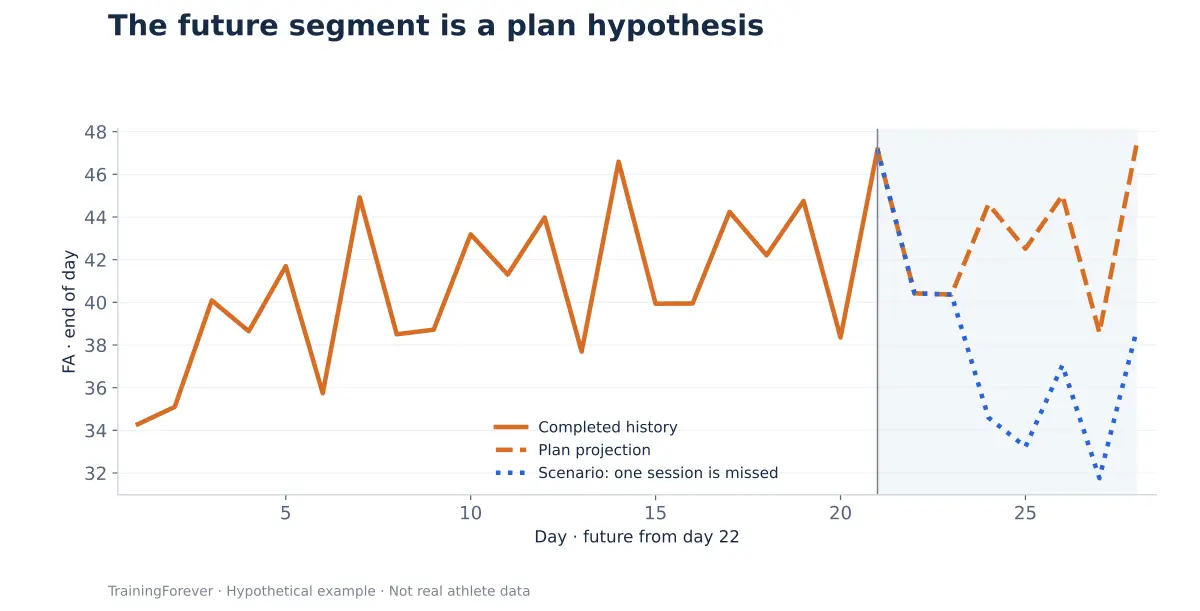
When the plan changes, the projection must change too. Its usefulness is to explore the distribution of load you are proposing, not to announce how someone will feel in a week's time.
Four reasons for a large difference
| Reason | What to check |
|---|---|
| Different duration | Valid minutes and recoveries |
| Different intensity | Blocks performed and threshold used |
| Different method | Plan by pace and execution by HR, for example |
| Incomplete data or structure | Sync, zones and estimates |
In intervals, the midpoint of a planned zone does not exactly predict what the athlete will end up doing. Pauses, terrain and conditions add legitimate differences.
How the plan's load is estimated
The documentation describes an estimate based on steps, durations, zones and thresholds. The sport branches have their own aggregation rules. When there is not enough data, the value must be identified as estimated.
To compare with execution, use the same discipline, period, unit and calculation criterion whenever possible. In strength, planned and completed CT use the same normalized session RPE scale: minutes × RPE ÷ 7.5 × 100 ÷ 60. A 45-minute session at RPE 6 is 60 CT in both cases, not 270 raw units. Differences usually come from elsewhere: planned strength minutes are the planned duration minus the endurance parts, the planned RPE is the average of the exercises weighted by sets, and if the completed activity arrives without intensity data or execution RPE, its CT is estimated by duration.
Its sporting meaning
It allows training to be adapted to what happened. Success is maintaining an effective and achievable plan, not forcing an exact match between two columns.
What this explanation is based on
- Bourdon PC et al. (2017). Monitoring Athlete Training Loads: Consensus Statement. It provides the basis for training monitoring; it does not imply that a forecast must be met to the decimal.
The references support concepts and limits. The numerical examples on this page are educational; they are not results from those studies.