
By JuanPa, creator of TrainingForever · Updated 4 November 2026
Legacy weekly model. This page explains an earlier TrainingForever convention. Its figures are not directly comparable with the daily Evolución curves.
In scientific terminology, internal load refers to the body's response to exercise. In TrainingForever's old weekly model, the CI label was used to count hours.
It is worth explaining that difference from the outset. Calling a variable Internal Load does not turn time into a measurement of physiological effort.
A simple example
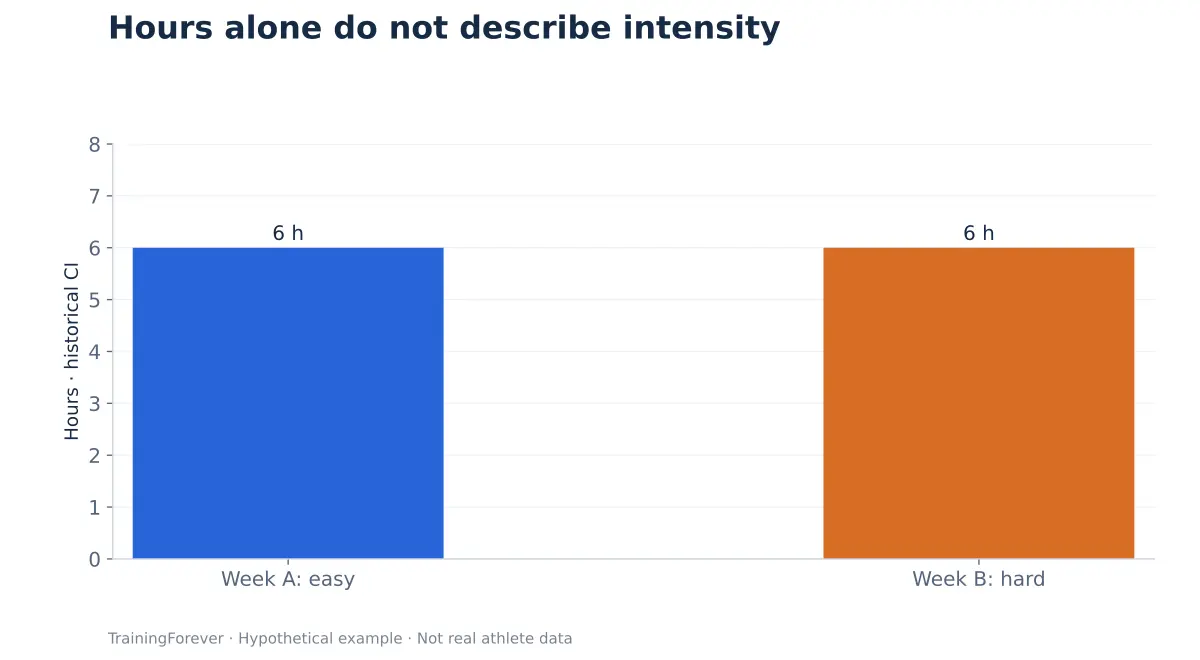
A week with six mainly easy hours and another with six hours containing a lot of intense work add up to the same value. To understand the difference, you have to open the sessions.
Case: the hours stay the same, but the week changes
Inés's coach keeps six hours and replaces two easy runs with quality sessions. The hourly volume does not change; the intensity distribution does.
If you rely only on historical CI, that change stays hidden. Time in Zones, RPE and content help you understand it better. In the current model, it is also worth reviewing CT and its origin, without assuming perfect equivalence between methods.
What counting hours is still good for
Hours are useful for reviewing availability, continuity and training volume. A plan that asks for ten hours from someone who only has six available needs a practical adjustment, even if all their curves look well calculated.
It is also worth keeping the discipline: an hour in the pool and an hour of running are not simply interchangeable because they last the same.
Calculation and main limitation
Historical_CI = sum of hours in the week.
It is a description of duration. It does not introduce intensity or directly capture sleep, discomfort or cardiovascular response. To talk about internal load in the physiological sense, identify the specific signal: heart rate, perceived effort or another assessed response.
How to use it in a conversation
"This week the hours stay the same, but the content changes. Let's review how the intensity was distributed and how you experienced it." That way volume provides context without attributing a precision it does not have.
What this explanation is based on
- Bourdon PC et al. (2017). Monitoring Athlete Training Loads: Consensus Statement. Distinguishes the concepts of internal and external load.
The references support concepts and limitations. The numerical examples on this page are didactic; they are not results from those studies.