By JuanPa, creator of TrainingForever · Updated 4 November 2026
The watch can record the same session two weeks in a row and the athlete can experience it in very different ways. Asking how hard it felt adds information the file does not contain.
RPE is the overall rating of perceived exertion. TrainingForever uses a scale from 1 to 10. It makes sense when the person understands the question and answers with a consistent criterion.
What to ask exactly
"How demanding did the session feel as a whole?" helps more than "how hard did you go on the toughest rep?". One question rates the whole session; the other rates a peak.
Agree on when to record it and stick to that procedure. Avoid leading the answer with phrases like "today was easy, right?". A discrepancy between what was planned and what was perceived is useful information.
The same minutes can tell another story
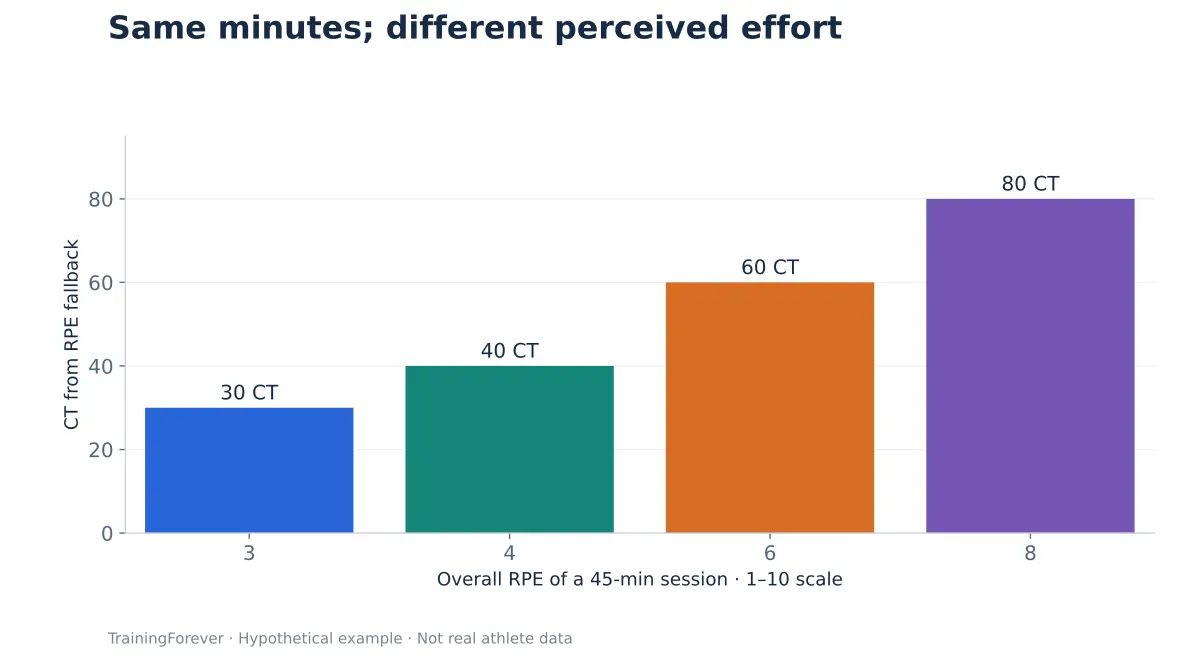
| 45-minute session | Load by RPE fallback |
|---|---|
| RPE 3 | 30 CT |
| RPE 4 | 40 CT |
| RPE 6 | 60 CT |
| RPE 8 | 80 CT |
Case: the easy session that stopped feeling easy
Marcos usually describes his regular easy run as RPE 3 or 4. In two comparable sessions he reports 6 and comments that he struggles to finish.
There is no need to turn that answer into an immediate conclusion about his form. First check sleep, stress, temperature, actual pace and recent training. If the discrepancy persists, you will have more reason to adjust the plan and keep observing.
The data gains value from the pattern within the same person. Comparing a 6 from Marcos with a 6 from another athlete is far less informative.
And in strength work
A global RPE helps track the perceived effort of a strength session, but it does not replace reps, loads, rest periods or proximity to failure in each set. Nor should it be confused with the specific RPE of a set or with reps in reserve.
Two strength sessions with the same RPE and duration can have very different contents. If you want to track strength progression, keep the record of exercises and sets.
How it relates to CT
The general fallback branch described uses CT_RPE = 100 × (RPE × minutes) / 450. It is an internal transformation to integrate it into the app's scale.
The session-RPE method in the literature is usually expressed as duration in minutes times RPE, in arbitrary units. Therefore, the two figures must not be exchanged without their conversion.
If a sensor is missing but there is a valid RPE, the record still provides information. If there is no RPE either and it is estimated by duration, that load must be recognized as estimated; it is not the same as having asked the athlete.
A simple application
Review the sessions whose perceived effort drifted from the target. The purpose is to understand and adjust: not to get the person to score what the coach expected.
What this explanation is based on
- Foster C et al. (2001). A new approach to monitoring exercise training. Study of monitoring through overall perceived exertion. It does not validate TrainingForever's own CT scale.
The references support concepts and limits. The numerical examples on this page are educational; they are not results from those studies.