
By JuanPa, creator of TrainingForever · Updated 4 November 2026
Historical weekly model. This page explains an earlier TrainingForever convention. Its figures are not directly comparable with the daily Evolución curves.
In the mountains, duration does not capture everything a route demands. Elevation gain adds information, but it does not represent the entire external demand either.
In the old weekly model, CE was accumulated elevation gain. The label should not be read as a complete measure of mechanical stress.
Same hours, different routes
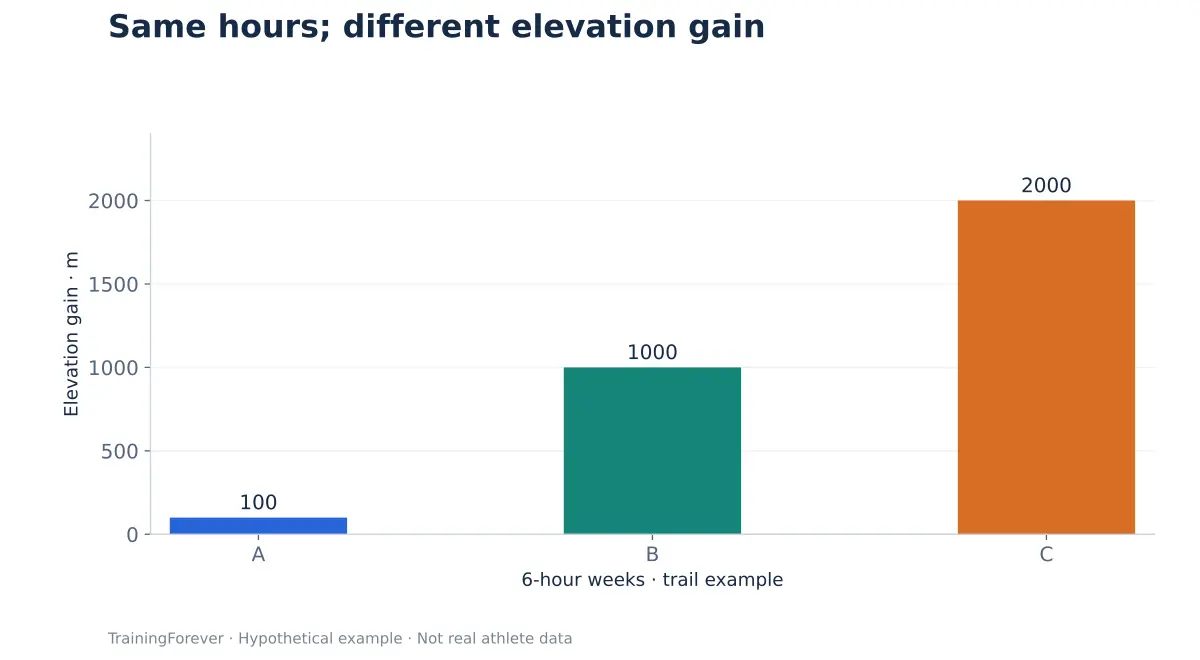
If a runner goes from six nearly flat hours to six hours with a lot of climbing, looking only at time hides part of the change. Historical CE makes D+ visible, but it still does not describe every element of the route.
Case: a technical descent is added
Two routes can share time and elevation gain. One descends on an easy track; the other, on a trail with steps and braking.
D+ can match while the muscular and technical experience differs. If the athlete ends up far more loaded on the second, the coach does not need to dismiss that information just because CE shows the same number.
What to add to the analysis
- Negative elevation and the characteristics of the descents.
- Surface, technical difficulty and changes of footing.
- Duration, distance and movement speed.
- The athlete's recent experience on that terrain.
Not all of these aspects are quantified by the product. A note on the route and how it felt afterwards can fill in what the indicator leaves out.
Historical calculation
Historical_CE = meters of D+ in the week.
The old generator incorporated that figure into its CT through 0.1 × D+. It is a software weighting, not a universal equivalence between meters climbed and fatigue.
In the current daily model there may be grade-adjusted pace. The historical term should not be automatically carried over to a session that is already adjusted.
Its sporting meaning
It helps monitor how exposure to the mountains changes. To organize a trail progression, also keep your attention on the real terrain and on the person's response.
What this explanation is based on
- Minetti AE et al. (2002). Energy cost of walking and running at extreme uphill and downhill slopes. Studies energy cost on slopes. It does not validate D+ as a complete measure of mechanical demand.
The references support concepts and limits. The numerical examples on this page are didactic; they are not results from those studies.