
By JuanPa, creator of TrainingForever · Updated 4 November 2026
A kilometre at 7:00 on a climb can demand more than another at 5:00 on the flat. Reading both by the stopwatch alone can lead you to ask for more intensity precisely when the athlete is already working hard enough.
Grade adjustment gives back part of the context that raw pace loses. It does not turn a technical trail into a running track.
What it tries to represent
Flat-equivalent speed estimates what output would correspond to the cost of moving over a gradient. TrainingForever uses a gradient-based cost model when the necessary data series are available.
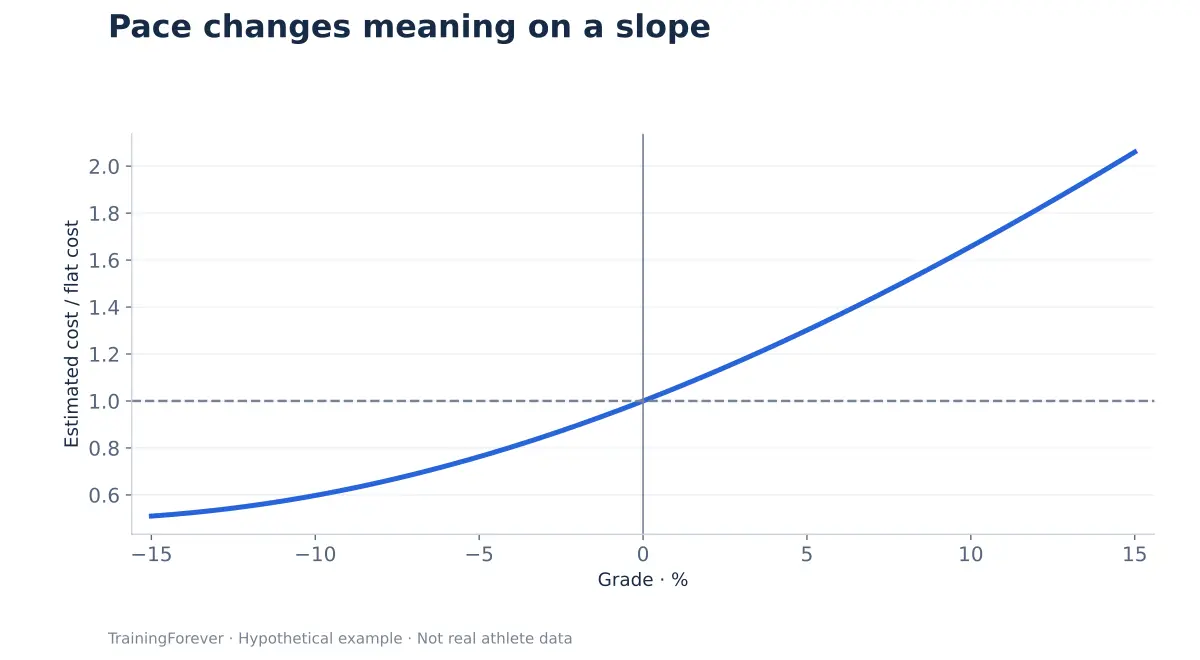
Case: it looks slow, but it isn't easy
Pablo is preparing a mountain race. On Tuesday he does an easy run on the flat and on Saturday he climbs along a fire road. His average pace on Saturday is much slower, even though his heart rate and perceived effort are higher.
Before concluding that he has lost fitness, separate gradient from surface. Equivalent speed can help interpret the metabolic component of that climb; raw pace on its own does not offer that comparison.
On a technical descent, the problem can be reversed: a relatively moderate metabolic cost coexists with muscle tension, braking and a lot of attention. A contained CT does not guarantee a session that is easy to recover from.
How to use it when reviewing a week
| Situation | Useful reading |
|---|---|
| Same route, similar conditions | More interpretable comparison |
| One flat route and another with a lot of climbing | Add gradient and duration |
| Technical descents or unstable terrain | Add muscular and technical demand |
| GPS or altitude with jumps | Check the data before adjusting |
A change in the altitude file can produce a change in the metric. The coach needs to distinguish it from a change in the athlete.
Two calculation paths worth recognising
According to the product guide, if speed and gradient are available, intensity can be based on equivalent speed. If that data is missing, a simpler approximation is used and CT may incorporate an elevation gain term.
That term is not added again when the effect of gradient is already incorporated. Otherwise, part of the climb's demand would be counted twice.
The mathematical detail can wait until the end
The model transforms speed using the ratio between cost on a gradient and cost on the flat. The cost comes from a Minetti polynomial. You don't need to memorise it to make decisions: you do need to know what information it introduces and what demand it leaves out.
Don't use it to treat two routes with very different terrain as equivalent, kilometre by kilometre. Footwear, mud, turns and technical ability also change the experience.
One decision that does help
If a long run left more muscle fatigue than expected, review duration, descents and terrain before increasing the next one because CT "came out low". In trail running, what the route contains completes a large part of the reading.
What this explanation is based on
- Minetti AE et al. (2002). Energy cost of walking and running at extreme uphill and downhill slopes. Experimental basis of the gradient cost model. It does not validate every CT adjustment in the app.
The references support concepts and limits. The numerical examples on this page are educational; they are not results from those studies.