By JuanPa, creator of TrainingForever · Updated 4 November 2026
Historical weekly model. This page explains an earlier TrainingForever convention. Its figures are not directly comparable with the daily Evolución curves.
Comparing two routes by kilometres alone can hide a big difference in climbing. An equivalent distance adds an elevation gain term to summarise part of the route.
It is a descriptive convention. It does not turn a mountain route into physiologically or mechanically identical flat kilometres.
An example with 20 kilometres
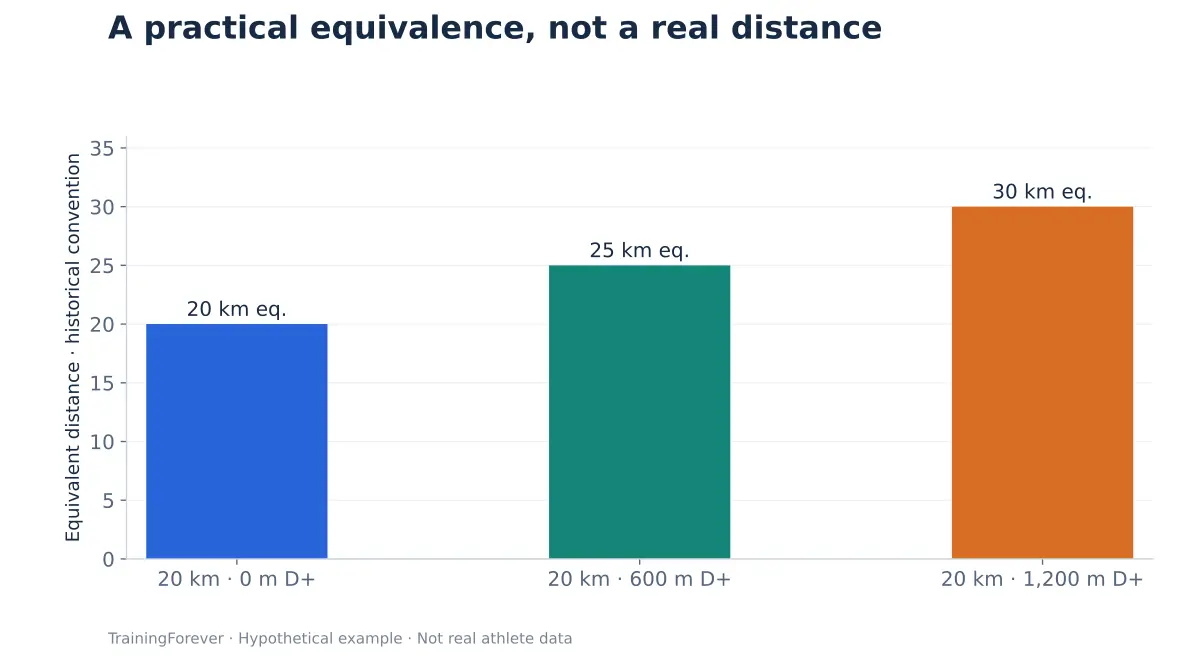
| Actual distance | D+ | Historical equivalent distance |
|---|---|---|
| 20 km | 0 m | 20 km eq. |
| 20 km | 600 m | 25 km eq. |
| 20 km | 1,200 m | 30 km eq. |
How to read it
The figure makes it easier to roughly compare routes that share a distance but have different climbs. It does not determine the pace the athlete should hold or how long they will take to recover.
Two routes of 30 equivalent kilometres can have different durations and difficulty. A climb on a fire road and a highly technical one do not become equal when the formula is applied.
Case: the long workout changes
The coach swaps a flat route for one with a fair amount of D+. The equivalent distance helps show that not everything has stayed the same, even though the number of kilometres is identical.
The next review is specific: expected time, type of climb, descent, recent experience and the purpose of the session. Those details decide whether the change fits.
Calculation and versions
The historical documentation describes D_eq = kilometres + D+_metres / 120. It also mentions an earlier variant with a divisor of 100. Each one produces different results.
When you compare old files or notes, state which one was used. Do not mix values from both versions and attribute the difference to a change in the athlete.
What it means for sport
It can serve as an indicative summary of a route. To calculate or interpret current load, use the corresponding model and activity data. Equivalent distance should not be added as an extra load without a defined rule that prevents the same elevation gain from being counted twice.
What this explanation is based on
- Minetti AE et al. (2002). Energy cost of walking and running at extreme uphill and downhill slopes. Basis for the slope context; it does not validate the divisor of 120 in this convention.
The references support concepts and limits. The numerical examples on this page are educational; they are not results from those studies.