By JuanPa, creator of TrainingForever · Updated 4 November 2026
Historical weekly model. This page explains an earlier TrainingForever convention. Its figures are not directly comparable with the daily Evolución curves.
A plan generator can build in limits so that its proposals don't grow unchecked. In the old weekly model, the so-called fatigue budget was one of those rules.
It is a programming safeguard. The name does not mean it measures how much fatigue a person can biologically tolerate.
An example of the budget
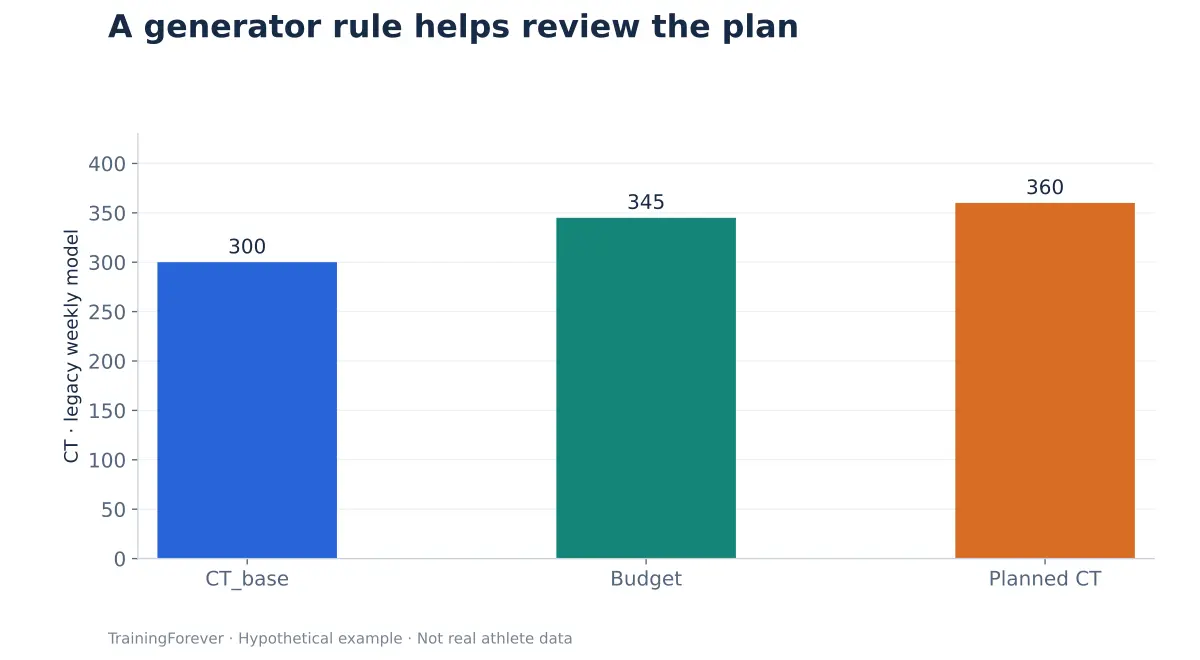
With a base of 300 and a multiplier of 1.15, the budget comes out at 345. A proposal of 360 exceeds that rule and deserves review within the generator.
It was not the only condition
The documentation also describes a weekly Acute Fatigue check against 1.20 × weekly Chronic Adaptation. They are two different references, although both were intended to contain the progression of the proposal.
In that model, Acute Fatigue was the weekly Total Load itself. A daily Acute Fatigue from the Evolución panel should not be fed into these checks.
Case: a specific mountain week
The proposal adds elevation gain to prepare for a race. Hours rise only slightly, but the historical Total Load exceeds the budget because it includes D+.
Before cutting it, the coach checks whether it was a deliberate block, what terrain it involves and how the athlete is arriving. The generator flagging the week invites review; it does not prove it will cause a problem.
If the proposal stems from a duplicated data point or a poorly estimated base, the solution is to correct the input. Adjusting real training to compensate for a logging error makes no sense.
Calculation and meaning
Budget = Base_Total_Load × 1.15.
Additional check: weekly_Acute_Fatigue ≤ 1.20 × weekly_Chronic_Adaptation.
The values 1.15 and 1.20 are product choices. They should not be presented as scientifically safe percentages. The same limit does not capture all the differences in training age, content, breaks or availability.
What it gives the coach
An automatic rule can help flag proposals that need attention. Professional review should keep the goal, the context and the individual response as decision criteria.
What this explanation is based on
- Impellizzeri FM et al. (2020). Acute:Chronic Workload Ratio: Conceptual Issues and Fundamental Pitfalls. A context of caution when attributing injury effects to load ratios.
The references support concepts and limits. The numerical examples on this page are educational; they are not results from those studies.