By JuanPa, creator of TrainingForever · Updated 4 November 2026
Historical weekly model. This page explains an earlier TrainingForever convention. Its figures are not directly comparable with the daily Evolución curves.
To propose training you need a reference for what the person has been doing. The old weekly generator used a Base Total Load calculated from averages of hours and elevation gain.
An average helps to start the calculation, but on its own it does not describe current preparedness. What matters is how the training was distributed and what has happened most recently.
Same average, different continuity
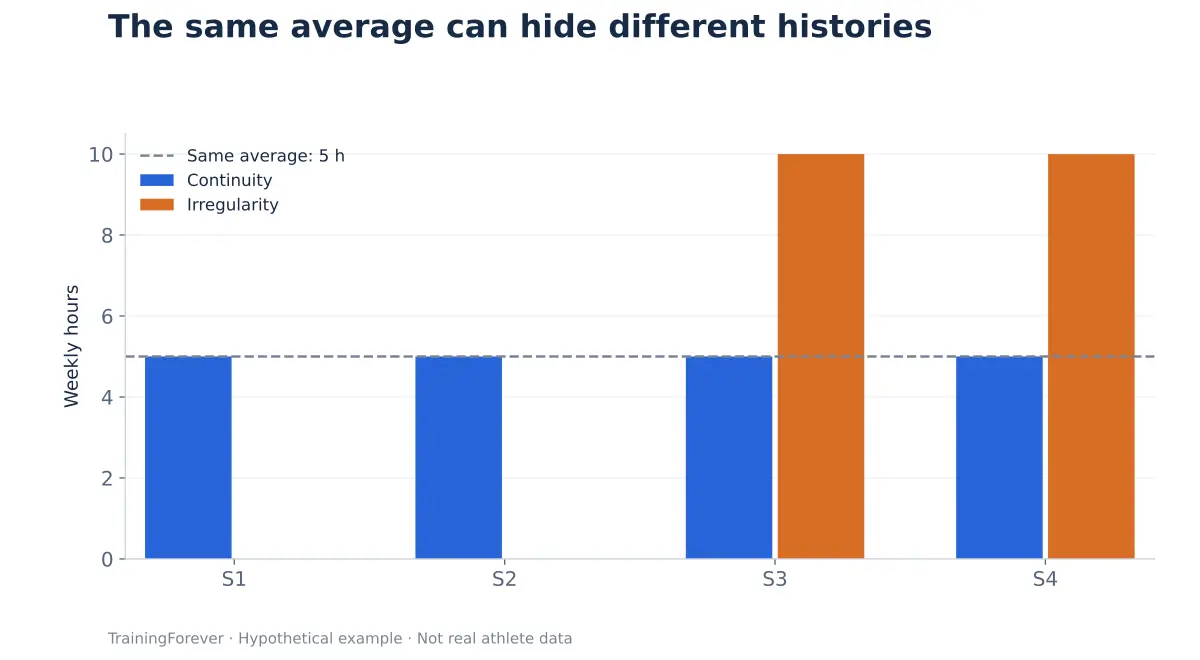
The average does not distinguish a stable continuity from two weeks without training followed by two very loaded ones. Nor does it allow intensity or specificity to be reconstructed.
Case: an irregular history is imported
Sergio presents several weeks of uneven load. The generator obtains a reference that looks reasonable, but the coach discovers that the history contains pauses and a recent change in availability.
Before accepting the proposal, review complete weeks, missing activities and what Sergio can sustain now. Copying the average into the calendar could repeat the irregularity you are trying to resolve.
Historical calculation
Base_Total_Load = 55 × average_weekly_hours + 0.1 × average_weekly_D+.
The model could use that base to initialise four previous weeks of the generator. This is a mathematical start: it does not add four weeks of training that actually happened.
What to check when using that reference
- That the history is complete and represents a relevant period.
- That the averages do not hide prolonged pauses.
- That future availability allows the proposed plan.
- That the disciplines and intensity make sense for the goal.
If data are missing, acknowledge that uncertainty and rebuild the context with the athlete. Presenting a figure with several decimal places does not make up for an incomplete history.
Its sporting meaning
It serves as an indicative starting point for an old calculation. The first week of the plan must be adjusted to the current situation; it does not have to reproduce that average automatically.
What this explanation is based on
- Bourdon PC et al. (2017). Monitoring Athlete Training Loads: Consensus Statement. General context for individual monitoring; it does not validate these coefficients or the historical initialisation.
The references support concepts and limits. The numerical examples on this page are didactic; they are not results from those studies.