
By JuanPa, creator of TrainingForever · Updated 4 November 2026
In the pool, a 60-minute session can contain well under 60 minutes of swimming. And two swimmers recording the same times can be working at different Relative Intensities.
CSS serves as an individual reference for interpreting swim pace. It is best used alongside the type of set, technique, rest periods and quality of execution.
What it represents
CSS stands for critical swim speed. It is obtained through testing protocols and used as an intensity reference. It is not a guarantee that you can hold exactly that pace for any duration.
The relationship between distance and time across the efforts tested allows that speed to be estimated. The result depends on the protocol and on how the tests were executed.
An example with the same CSS
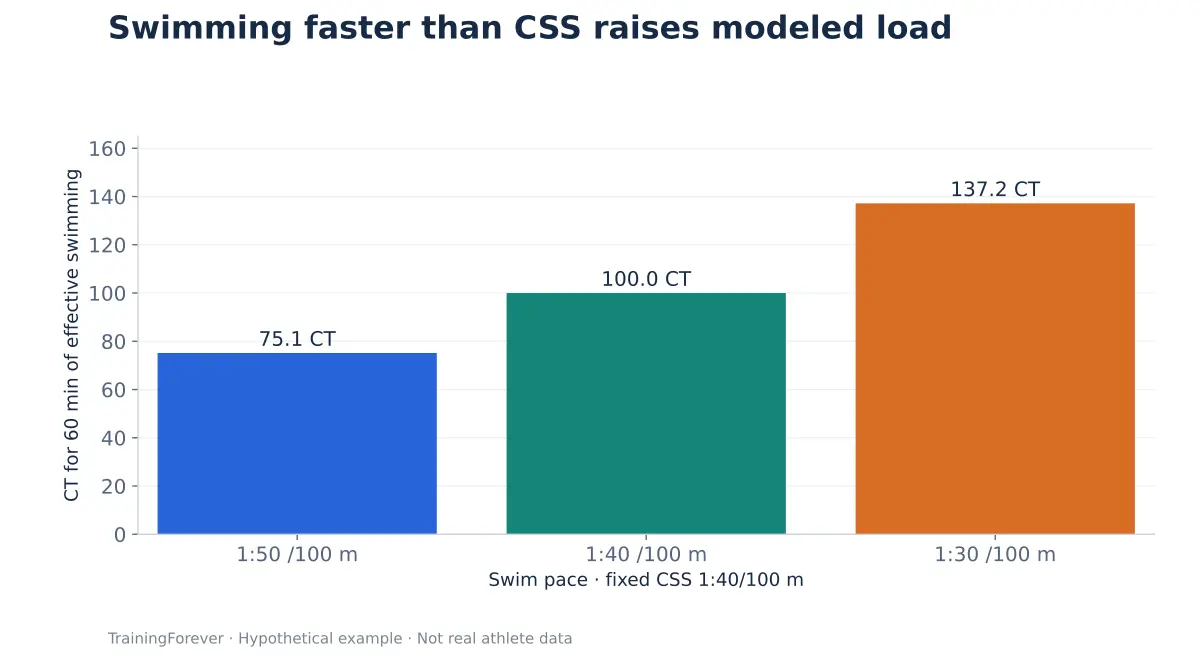
| Pace | IR relative to CSS 1:40/100 m | CT over 60 effective minutes |
|---|---|---|
| 1:50/100 m | 0.91 | 75.1 |
| 1:40/100 m | 1.00 | 100.0 |
| 1:30/100 m | 1.11 | 137.2 |
The last row is a teaching calculation. It does not prescribe an hour at that intensity, nor does it claim the swimmer can complete it.
Case study: a long session with little swim load
Marta spends 70 minutes at the pool, but part of that goes on instructions, rest and technique practice. She swims 40 effective minutes.
If the app uses swimming time and the coach had estimated the whole pool visit, a load difference will appear. That does not mean the technique session was of little value: it means the metric summarises one specific aspect.
Before adding metres to match the CT, check whether the technical objective was met. Learning does not have to show up as a high load.
How I would review a demanding set
Look at whether the times hold, how much rest is needed and how technique changes. One successful repetition does not prove the whole session was executed at that intensity. The average summary can hide both recoveries and late deterioration.
If you use paddles, fins or stroke changes, add that context. The same time per 100 metres does not necessarily carry the same meaning.
How the app calculates it
Intensity is obtained from speeds. Using comparable paces in seconds per 100 metres: IR = CSS pace / actual pace.
Load by CSS uses CT = swimming hours × 100 × IR³. The exponent is a modelling decision, not a demonstrated individual physiological response. Without sufficient CSS, the running heart rate threshold should not be imported as if it were a swimming one.
What to check when CSS changes
Check the protocol, pool length, effort and validity date. A new CSS changes the reference point: it can lower the calculated IR at a given pace without the swimmer having slowed down.
The sporting point is to improve prescription and its follow-up. The goal is not to achieve a maximum CT, but to accumulate the swim stimulus that makes sense for that person.
What this explanation is based on
- Wakayoshi K et al. (1992). Determination and validity of critical velocity as an index of swimming performance in the competitive swimmer. Examines critical velocity as a performance index in swimmers.
The references support concepts and limits. The numerical examples on this page are for teaching purposes; they are not results from those studies.